Molecular Distillation: Which Materials Are Suitable for the Process?
- 2026-9-23
Table of Contents
Introduction
H1: Molecular Distillation: Which Materials Are Suitable for the Process?
When selecting a molecular distillation system, one of the first questions customers usually ask is:
“Can my material be processed by molecular distillation?”
The answer depends on more than the material name.
Material composition, boiling characteristics, thermal stability, viscosity, volatility, target components, required purity, and processing capacity all affect whether molecular distillation is an appropriate separation method.
Molecular distillation is particularly useful for certain high-boiling-point, heat-sensitive, and high-value materials that require gentle separation under high vacuum conditions.
However, not every material is suitable for direct molecular distillation. In some applications, pretreatment such as solvent removal, filtration, concentration, or thin film evaporation may be required before the material enters the molecular distillation system.
This article explains the key factors to consider when evaluating a material for molecular distillation and how to select a suitable process and equipment configuration.
What Is Molecular Distillation?
H2: What Is Molecular Distillation?
Molecular distillation is a high-vacuum separation process that utilizes differences in the volatility and molecular behavior of components.
Under high vacuum, the boiling temperature of materials can be significantly reduced. The feed material is distributed over a heated evaporation surface, usually forming a thin film with the help of a wiper or rotating film system.
More volatile components evaporate from the surface and travel a short distance before being condensed and collected.
A typical molecular distillation process includes:
Feed → Heating → Thin-Film Formation → Evaporation → Short-Distance Condensation → Light Fraction / Heavy Fraction Collection
Compared with conventional distillation, molecular distillation can provide a relatively short residence time and reduced thermal exposure for suitable materials.
This makes it particularly useful for materials that are difficult to process using conventional high-temperature distillation.
What Materials Are Suitable?
H2: Which Materials Are Suitable for Molecular Distillation?
There is no single material category that automatically guarantees suitability. However, molecular distillation is commonly considered for the following types of materials.
H3: 1. High-Boiling-Point Materials
High-boiling-point materials are one of the important application areas for molecular distillation.
At atmospheric pressure, some compounds require very high temperatures to vaporize. Prolonged exposure to such temperatures may cause thermal degradation or unwanted chemical reactions.
Under high vacuum, the evaporation temperature can be reduced.
Therefore, molecular distillation can be considered for selected high-boiling materials such as:
- Fatty acids
- Special oils
- High-boiling organic compounds
- Fine chemicals
- Certain chemical intermediates
- High-molecular-weight liquid components
However, a high boiling point alone does not mean that molecular distillation is automatically suitable.
The actual vapor pressure, thermal stability, viscosity, and separation target must also be evaluated.
Heat-Sensitive Materials
H3: 2. Heat-Sensitive Materials
Some materials are sensitive to prolonged heating.
Typical problems may include:
- Oxidation
- Decomposition
- Polymerization
- Discoloration
- Loss of active components
- Changes in odor or flavor
- Reduction in product quality
Molecular distillation may provide advantages for suitable heat-sensitive materials because the process operates under high vacuum and the material can pass through the heated evaporation zone relatively quickly.
Typical application areas include:
- Essential oils
- Natural extracts
- Specialty oils
- Certain pharmaceutical intermediates
- Fine chemicals
- Heat-sensitive organic compounds
The actual operating temperature should be determined according to the thermal stability and evaporation characteristics of the specific material.
Oils, Fatty Acids and Lipid-Based Materials
H3: 3. Oils, Fatty Acids and Specialty Fats
Oils and fatty-acid systems are important application areas for molecular distillation.
Depending on the composition and target product, molecular distillation can be used for:
- Removing light components
- Reducing high-boiling impurities
- Concentrating target components
- Deodorization
- Purification
- Separation of different fractions
Potential materials include:
- Fatty acids
- Natural oils
- Specialty oils
- Monoglycerides
- Lipid derivatives
- Lanolin derivatives
- Nutritional oils
The suitable operating temperature and vacuum level depend strongly on the specific composition of the feed material.
Essential Oils and Fragrance Materials
H3: 4. Essential Oils and Fragrance Materials
Essential oils and fragrance-related materials may contain multiple components with different volatility characteristics.
Molecular distillation can be considered when the objective is to modify the composition of the product by separating certain light or heavy components.
Possible purposes include:
- Removing unwanted volatile components
- Reducing heavy fractions
- Concentrating selected components
- Improving product characteristics
- Obtaining specific fractions
However, essential oils can be chemically complex. Therefore, the material should be evaluated based on its actual composition rather than simply its product name.
Plant Extracts and Natural Products
H3: 5. Plant Extracts and Natural Products
Plant extracts may contain a complex mixture of:
- Volatile compounds
- Oils
- Pigments
- Active ingredients
- High-boiling components
- Residual solvents
For some plant-derived materials, molecular distillation can be used as a downstream separation or concentration process.
A possible process could be:
Plant Extract → Pretreatment → Solvent Removal → Molecular Distillation → Target Fraction
For materials containing a large amount of water, ethanol, or other low-boiling solvents, pretreatment may be more appropriate before molecular distillation.
Silicone Oils and High-Viscosity Materials
H3: 6. Silicone Oils and Viscous Materials
Certain silicone oil systems and other viscous materials can be considered for molecular distillation.
The purpose may include reducing:
- Low-molecular-weight components
- Volatile fractions
- Residual low-boiling substances
For viscous materials, equipment selection becomes particularly important.
Important parameters include:
- Feed viscosity
- Operating temperature
- Flowability
- Film formation
- Wiper speed
- Heating capacity
- Residence time
If the material is too viscous to form a stable and uniform film, the expected separation performance may be affected.
Resins and Oligomers
H3: 7. Resins and Oligomers
Resins and oligomers are another potential application area, particularly when the objective is to remove volatile components rather than evaporate the main resin itself.
The target may include:
- Residual monomers
- Low-molecular-weight substances
- Residual solvents
- Volatile impurities
Because resin systems are often highly viscous, the feed system and film-forming performance should be carefully evaluated.
A suitable system may require special consideration of:
Heating → Feeding → Film Formation → Wiping → Vacuum → Condensation
Pilot testing is recommended for highly viscous or complex resin materials.
Materials That May Require Pretreatment
H2: Which Materials Should Not Be Directly Processed by Molecular Distillation?
Molecular distillation is not always the first step in a complete process.
For example, if the feed contains a large amount of low-boiling solvent, directly using molecular distillation may not be the most efficient approach.
A combined process may be more suitable:
Raw Material → Solvent Removal → Thin Film Evaporation → Molecular Distillation → Final Product
Thin film evaporation can handle the initial removal of large quantities of volatile components, while molecular distillation can then be used for more selective downstream separation.
This combination can be useful when the raw material contains both large quantities of light components and valuable high-boiling target components.
When Is Molecular Distillation Not the Best Choice?
H2: When Is Molecular Distillation Not Suitable?
Molecular distillation should not be considered the solution for every separation problem.
Other technologies may be more appropriate when:
1. Large quantities of solvent need to be recovered
If the primary objective is simply to recover ethanol, water, or another low-boiling solvent, conventional vacuum distillation or evaporation may be more practical.
2. The feed contains a large amount of solid material
High solid content may affect:
- Feeding
- Heat transfer
- Film formation
- Wiper operation
- Evaporation surface cleanliness
Pretreatment may therefore be necessary.
3. The material crystallizes easily
Rapid crystallization on the evaporation surface can lead to:
- Fouling
- Reduced heat transfer
- Feeding problems
- Equipment blockage
The melting point and crystallization behavior should be evaluated before equipment selection.
4. The separation is better suited to fractional distillation
If two components have suitable volatility differences and can be effectively separated through conventional fractional distillation, a molecular distillation system may not be necessary.
Molecular Distillation vs. Thin Film Evaporation
H2: Molecular Distillation vs. Thin Film Evaporation
Molecular distillation and thin film evaporation both use thin-film technology, but their process objectives can be different.
| Feature | Molecular Distillation | Thin Film Evaporation |
|---|---|---|
| Main purpose | Fine separation / purification | Concentration / solvent removal |
| Vacuum requirement | Usually very high | Application dependent |
| Typical materials | High-boiling and heat-sensitive materials | Solvents, concentrates, viscous materials |
| Residence time | Very short | Short |
| Separation focus | Light/heavy fraction separation | Removal of volatile components |
| Application | High-value products | Pretreatment and concentration |
In some industrial processes, the two technologies can be combined rather than used independently.
Key Parameters for Material Evaluation
H2: 10 Key Parameters to Check Before Selecting Molecular Distillation Equipment
Before recommending a molecular distillation system, customers should provide as much of the following information as possible:
1. Feed Composition
What substances are contained in the raw material?
2. Target Product
What component or fraction do you want to obtain?
3. Components to Be Removed
Which substances need to be separated or removed?
4. Boiling Point or Volatility
What are the boiling characteristics or vapor pressure of the target components?
5. Viscosity
How does the viscosity change with temperature?
6. Thermal Stability
At what temperature does the material begin to degrade, oxidize, or polymerize?
7. Solid Content
Does the feed contain suspended solids or particles?
8. Melting and Crystallization Characteristics
Can the material crystallize during operation?
9. Required Purity and Recovery
What purity and recovery rate are required for the final product?
10. Processing Capacity
How many kilograms or liters per hour/day need to be processed?
These parameters are much more useful for equipment selection than the material name alone.
Why Pilot Testing Matters
H2: Why Is Pilot Testing Recommended for Molecular Distillation?
For complex materials, theoretical data cannot always predict actual separation performance.
The same molecular distillation equipment may require completely different operating conditions for different materials.
Pilot testing can help determine:
- Suitable evaporation temperature
- Suitable vacuum level
- Feed rate
- Wiper speed
- Condensation temperature
- Film-forming performance
- Light and heavy fraction distribution
- Thermal stability
- Final product quality
For a new material, laboratory or pilot-scale testing can provide valuable data before moving to larger-scale equipment.
How Yuhua Helps With Equipment Selection
H2: Molecular Distillation Equipment Selection from Yuhua Instrument
Gongyi Yuhua Instrument Co., Ltd. provides laboratory and pilot-scale equipment for chemical, pharmaceutical, research, and other industrial applications.
For molecular distillation projects, equipment selection should begin with the material and process requirements rather than simply choosing a model based on capacity.
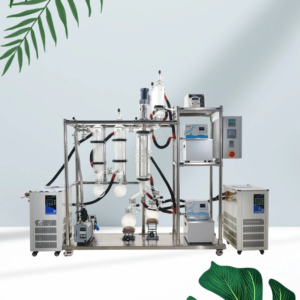
Depending on the application, a complete system may include:
- Molecular distillation unit
- Feed system
- Heating system
- Vacuum pump
- Condensation system
- Cooling system
- Collection system
- Temperature control system
The equipment configuration can be considered according to the material properties, target separation, processing capacity, and operating conditions.
For difficult or unfamiliar materials, pilot testing can also be considered before scale-up.
FAQ Matrix
H2: Frequently Asked Questions About Molecular Distillation
Q1: What materials are suitable for molecular distillation?
Molecular distillation is commonly considered for selected high-boiling-point, heat-sensitive, viscous, and high-value materials such as specialty oils, fatty acids, essential oils, natural extracts, silicone oils, resins, oligomers, and certain fine chemicals.
Q2: Can essential oils be processed by molecular distillation?
Some essential oils can be processed using molecular distillation, depending on their composition and separation target. The required temperature and vacuum conditions should be determined according to the actual material.
Q3: Is molecular distillation suitable for high-viscosity materials?
It can be suitable for certain high-viscosity materials, but viscosity and film formation are important factors. Pilot testing is recommended when the material has very high viscosity.
Q4: Can molecular distillation remove ethanol?
Molecular distillation may not be the most efficient choice when the feed contains a large amount of ethanol. A solvent-removal or thin-film evaporation step may be considered before molecular distillation.
Q5: What information is required to select molecular distillation equipment?
The most useful information includes feed composition, target product, components to remove, viscosity, thermal stability, volatility, solid content, required purity, recovery rate, and processing capacity.
Q6: Is molecular distillation the same as short path distillation?
The terms are often used in closely related contexts, especially for equipment using a short evaporation-to-condensation path under high vacuum. However, the exact equipment configuration and process design should be considered when comparing systems.
Final CTA
H2: Need Help Selecting a Molecular Distillation System?
Choosing molecular distillation equipment should start with the material properties and separation objective, not simply the name or capacity of the equipment.
If you are evaluating a molecular distillation process, you can provide:
Material composition + target component + components to remove + viscosity + thermal stability + processing capacity
Based on these parameters, the appropriate process can be further evaluated, including molecular distillation, thin film evaporation, vacuum distillation, or a combined process.
Contact Yuhua Instrument to discuss your material and molecular distillation requirements.
Molecular Distillation: Which Materials Are Suitable for the Process?
Molecular Distillation: Which Materials Are Suitable for the Process? 2026-9-23 Table of Contents Introduction H1: Molecular Distillation: Which Materials Are Suitable for the Process? When
High & Low Temperature Circulator | Reactor Temperature Control System
High & Low Temperature Circulator | Reactor Temperature Control 2026-9-20 Table of Contents Introduction A high & low temperature circulator is a temperature control system
Glass Reactor: Efficient Solution for Laboratory Chemical Reactions
H1标题 2026-8-27 Table of Contents Glass Reactor | Laboratory Reactor for Heating, Cooling & Mixing A glass reactor is a laboratory reaction vessel designed for
Rotary Evaporator: Efficient Vacuum Evaporation for Laboratory and Pilot-Scale Applications
Rotary Evaporator for Efficient Vacuum Evaporation & Solvent Recovery 2026-8-27 Table of Contents Rotary Evaporator for Efficient Vacuum Evaporation & Solvent Recovery A rotary
Laboratory High and Low Temperature Circulator
Laboratory High and Low Temperature Circulator 2026-8-27 Table of Contents What Is a Laboratory High and Low Temperature Circulator? A Laboratory High and Low Temperature
Laboratory Glass Reactor
Laboratory Glass Reactor 2026-8-31 Table of Contents What Is a Laboratory Glass Reactor? A laboratory glass reactor is a reaction vessel equipped with temperature