
H1标题
- 2026-8-27
Table of Contents
Glass Reactor | Laboratory Reactor for Heating, Cooling & Mixing
A glass reactor is a laboratory reaction vessel designed for controlled chemical reactions, synthesis, mixing, heating and cooling. With a transparent glass vessel, researchers can observe the reaction process directly while controlling important operating parameters such as temperature, stirring speed and vacuum.
Glass reactors are widely used in chemical synthesis, pharmaceutical research, material development, extraction, crystallization and other laboratory processes.
A jacketed glass reactor can be connected to an external heating and cooling temperature control system to maintain the required reaction temperature. Depending on the process requirements, the reactor can also be equipped with a mechanical stirring system, condenser, vacuum connection, feeding port and other accessories.
Yuhua provides laboratory glass reactor solutions in different volumes and configurations to meet different laboratory research and process development requirements.
What Is a Glass Reactor?
A glass reactor is a laboratory-scale reaction vessel used to perform chemical reactions under controlled conditions.
Compared with a conventional container, a laboratory reactor integrates multiple functions into one controlled reaction system. The reactor can provide controlled:
- Heating
- Cooling
- Stirring
- Vacuum operation
- Material feeding
- Condensation
- Temperature monitoring
The glass vessel also allows users to visually monitor the reaction process, making it particularly useful for laboratory research and chemical process development.
Depending on the application, a glass reactor can be configured as a single-wall or jacketed reactor. Jacketed designs are commonly used when accurate heating or cooling of the reaction mixture is required.
How Does a Glass Reactor Work?
A glass reactor works by combining a reaction vessel with temperature control, stirring and other auxiliary systems.
The basic operating process can be described as:
Materials → Feeding → Stirring → Heating/Cooling → Reaction → Condensation/Vacuum → Product Collection
Each component performs a specific function during the reaction.
H3:Heating
Heating is used to raise the temperature of the reaction mixture to the required operating temperature.
A jacketed glass reactor can circulate a heating medium through the jacket. The heating medium can be supplied by an external temperature control system.
This configuration provides more controlled and uniform heating than directly heating the reaction mixture.
H3:Cooling
Cooling is required for reactions that generate heat or need to be maintained at a low temperature.
The reactor jacket can circulate a cooling medium supplied by a temperature control unit.
The cooling system can help maintain a stable reaction temperature and reduce the risk of excessive temperature rise during the process.
H3:Mixing and Stirring
A stirring system keeps the materials uniformly mixed during the reaction.
Different agitator designs can be selected according to:
- Liquid viscosity
- Solid content
- Working volume
- Mixing requirements
- Reaction characteristics
A mechanical stirrer is commonly used for laboratory glass reactors requiring continuous and controlled mixing.
H3:Vacuum Operation
Some laboratory processes require operation under reduced pressure.
A glass reactor can be connected to a vacuum pump through the reactor’s vacuum connection.
Vacuum operation can be used for processes such as:
- Vacuum reaction
- Solvent removal
- Concentration
- Low-temperature evaporation
- Vacuum distillation
The appropriate vacuum equipment should be selected according to the process and chemical requirements.
What Is a Jacketed Glass Reactor?
A jacketed glass reactor has an additional jacket surrounding the main reaction vessel.
The reaction material is placed inside the inner vessel, while a heating or cooling medium circulates through the jacket.
The basic structure is:
Temperature Control System → Reactor Jacket → Heat Transfer → Reaction Material
This design allows the reaction temperature to be controlled without directly contacting the heating or cooling medium with the process material.
Advantages of a Jacketed Glass Reactor
- Controlled heating
- Controlled cooling
- More uniform temperature distribution
- Suitable for temperature-sensitive reactions
- Easy integration with external temperature control equipment
- Suitable for laboratory research and process development
For applications requiring both heating and cooling, a temperature control system can be selected according to the required operating temperature range.
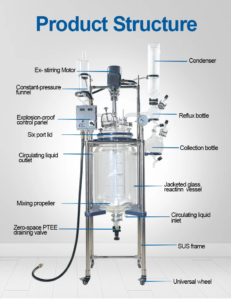
Main Components of a Glass Reactor
A complete glass reactor system normally consists of several components.
1. Glass Reactor Vessel
The reactor vessel is the main container for the chemical reaction.
Its volume should be selected according to the required working volume and process conditions.
Common laboratory capacities include:
- 1 L
- 2 L
- 5 L
- 10 L
- 20 L
- 30 L
- 50 L
- 100 L
Larger capacities can also be considered for pilot-scale applications.
2. Reactor Jacket
The jacket provides the heat-transfer space around the reaction vessel.
It can be connected to:
- Heating circulator
- Cooling circulator
- High and low temperature control system
3. Stirring System
The stirring system consists of a motor, shaft and agitator.
It provides continuous mixing during the reaction and helps improve material uniformity.
4. Temperature Sensor
A temperature sensor monitors the reaction temperature.
The measured temperature can be displayed or integrated with the temperature control system.
5. Condenser
A condenser is used to condense vapors generated during heating or reaction.
It is particularly useful when working with volatile solvents.
6. Feeding Port
The feeding port allows raw materials, solvents or reagents to be added to the reactor.
Depending on the application, different feeding methods can be configured.
7. Vacuum Connection
A vacuum connection allows the reactor to be connected to a vacuum pump.
This configuration can be used for vacuum reactions and other reduced-pressure processes.
8. Control System
The control system can integrate operating parameters such as:
- Temperature
- Stirring speed
- Heating
- Cooling
- Vacuum
The actual configuration depends on the reactor model and application.
Applications of Glass Reactors
Glass reactors are used in a wide range of laboratory and process-development applications.
H3:Chemical Synthesis
Glass reactors are commonly used for chemical synthesis and reaction development.
Typical processes include:
- Organic synthesis
- Inorganic synthesis
- Catalytic reactions
- Polymerization research
- Reaction optimization
The transparent vessel allows researchers to observe changes in color, phase and material condition during the reaction.
H3:Pharmaceutical Research
Laboratory glass reactors can be used during pharmaceutical research and process development.
Typical applications include:
- Pharmaceutical synthesis
- Formulation research
- Reaction development
- Process optimization
- Intermediate preparation
The reactor size and configuration can be selected according to laboratory-scale requirements.
H3:Material Research
Glass reactors can also be used for material development.
Applications may include:
- Polymer research
- Nanomaterial preparation
- New material synthesis
- Functional material development
- Chemical modification
Controlled temperature and stirring are important for maintaining repeatable experimental conditions.
H3:Extraction
Glass reactor systems can be used for certain laboratory extraction processes.
Depending on the process, the system can be configured with:
- Heating
- Stirring
- Condenser
- Vacuum
- Temperature control
The appropriate reactor material and configuration should be selected according to the extraction solvent and operating conditions.
H3:Crystallization
Glass reactors can be used for reaction crystallization and cooling crystallization research.
Temperature control is particularly important because crystallization behavior can be affected by:
- Cooling rate
- Temperature
- Concentration
- Stirring speed
- Solvent properties
A jacketed reactor can provide controlled heating and cooling during the crystallization process.
Glass Reactor for Heating and Cooling
Temperature control is one of the most important functions of a laboratory glass reactor system.
A jacketed glass reactor can be connected to a heating and cooling temperature control system.
Heating Process
Temperature Control Unit → Heating Medium → Reactor Jacket → Reaction Material
Cooling Process
Temperature Control Unit → Cooling Medium → Reactor Jacket → Reaction Material
This configuration allows users to adjust the reaction temperature according to the process requirements.
For applications involving both heating and cooling cycles, a high and low temperature circulation system can be selected.
Glass Reactor with Stirring System
Mixing performance directly affects many chemical reactions.
A glass reactor can be equipped with a mechanical stirring system to maintain material uniformity.
The appropriate agitator should be selected based on the material characteristics.
Important factors include:
- Viscosity
- Density
- Solid-liquid ratio
- Working volume
- Required mixing speed
- Reaction characteristics
For low-viscosity liquids, a conventional agitator may be sufficient.
For high-viscosity materials or systems containing solids, a different agitator design may be required.
Glass Reactor for Vacuum Applications
A glass reactor can be combined with a condenser and vacuum pump to create a vacuum reaction system.
A typical configuration is:
Glass Reactor → Condenser → Vacuum Receiver → Vacuum Pump
Vacuum operation can be useful for:
- Solvent evaporation
- Solvent recovery
- Concentration
- Vacuum reaction
- Low-temperature processing
- Vacuum distillation
The vacuum level, condenser capacity and vacuum pump should be selected based on the process requirements and solvent characteristics.
How to Choose the Right Glass Reactor?
Choosing a laboratory glass reactor requires more than simply selecting the vessel volume.
Consider the following factors.
1. Working Volume
The reactor should provide enough space for the actual reaction while allowing sufficient headspace.
Do not select reactor capacity based only on the total amount of material.
2. Temperature Range
Determine:
- Minimum operating temperature
- Maximum operating temperature
- Heating requirement
- Cooling requirement
- Required temperature stability
This information helps determine the appropriate temperature control system.
3. Stirring Requirement
Consider:
- Material viscosity
- Solid content
- Required mixing speed
- Agitator type
4. Vacuum Requirement
If the process requires reduced pressure, confirm:
- Required vacuum level
- Solvent type
- Condenser requirement
- Vacuum pump requirement
5. Chemical Compatibility
The glass material, seals, valves and other wetted components should be compatible with the chemicals being processed.
6. Reactor Configuration
Depending on the application, the system may require:
- Heating/cooling jacket
- Mechanical stirrer
- Condenser
- Feeding port
- Vacuum port
- Temperature sensor
- Bottom discharge
- Customized accessories
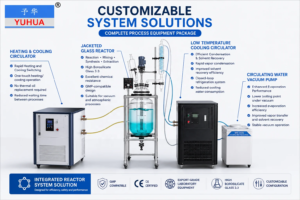
Glass Reactor System Configuration
A glass reactor does not always operate as an independent piece of equipment.
For many applications, a complete system may include several auxiliary devices.
Basic Laboratory Reactor System
Glass Reactor + Stirrer + Temperature Control
Suitable for:
- Chemical reactions
- Laboratory synthesis
- Material research
Vacuum Reactor System
Glass Reactor + Stirrer + Condenser + Vacuum Pump
Suitable for:
- Vacuum reactions
- Solvent evaporation
- Concentration
- Vacuum distillation
Heating and Cooling Reactor System
Glass Reactor + Stirrer + High/Low Temperature Control Unit
Suitable for processes requiring controlled heating and cooling.
Reactor with Condenser Cooling
For processes requiring efficient vapor condensation, a separate low-temperature circulator or chiller may be connected to the condenser.
Important: The reactor temperature control system and condenser cooling system serve different purposes. The reactor temperature control system mainly controls the temperature of the reactor jacket, while a chiller or low-temperature circulator can be used for condenser cooling.
Why Choose a Glass Reactor for Laboratory Research?
Glass reactors provide several practical advantages for laboratory research.
Visual Observation
The transparent vessel allows researchers to observe the reaction process directly.
Controlled Temperature
Jacketed designs allow external heating or cooling.
Controlled Mixing
A mechanical stirring system provides adjustable mixing.
Flexible Configuration
The reactor can be configured with condensers, vacuum systems, feeding ports and other accessories.
Suitable for Process Development
Different reactor sizes can be used as research moves from laboratory experiments toward pilot-scale development.
Glass Reactor Solutions from Yuhua
Temperature control is one of the most important functions of a laboratory glass reactor system.
A jacketed glass reactor can be connected to a heating and cooling temperature control system.
Heating Process
Temperature Control Unit → Heating Medium → Reactor Jacket → Reaction Material
Cooling Process
Temperature Control Unit → Cooling Medium → Reactor Jacket → Reaction Material
This configuration allows users to adjust the reaction temperature according to the process requirements.
For applications involving both heating and cooling cycles, a high and low temperature circulation system can be selected.
Frequently Asked Questions About Glass Reactors
What is a glass reactor used for?
A glass reactor is used for controlled laboratory chemical reactions, synthesis, mixing, heating, cooling and other research processes.
What is a jacketed glass reactor?
A jacketed glass reactor has an external jacket through which heating or cooling media can circulate to control the reaction temperature.
Can a glass reactor be used under vacuum?
Yes. A properly configured glass reactor can be connected to a vacuum pump for vacuum reactions, evaporation, concentration or other reduced-pressure processes.
Can a glass reactor be heated and cooled?
Yes. A jacketed glass reactor can be connected to an external heating and cooling temperature control system.
What size glass reactor do I need?
The appropriate volume depends on the required working volume, material characteristics, headspace and process requirements. Common laboratory sizes include 1 L, 2 L, 5 L, 10 L, 20 L and larger capacities.
Can a glass reactor be used for pharmaceutical research?
Yes. Laboratory glass reactors are commonly used for chemical synthesis, pharmaceutical research and process development, subject to appropriate material and process compatibility.
What is the difference between a glass reactor and a rotary evaporator?
A glass reactor is primarily designed for controlled chemical reactions, mixing and temperature-controlled processing. A rotary evaporator is primarily designed for vacuum evaporation, concentration and solvent recovery.
Can the glass reactor be customized?
Reactor configuration can be selected according to the application, including vessel volume, stirring system, condenser, feeding ports, temperature control and vacuum connections.
Molecular Distillation: Which Materials Are Suitable for the Process?
Molecular Distillation: Which Materials Are Suitable for the Process? 2026-9-23 Table of Contents Introduction H1: Molecular Distillation: Which Materials Are Suitable for the Process? When
High & Low Temperature Circulator | Reactor Temperature Control System
High & Low Temperature Circulator | Reactor Temperature Control 2026-9-20 Table of Contents Introduction A high & low temperature circulator is a temperature control system
Glass Reactor: Efficient Solution for Laboratory Chemical Reactions
H1标题 2026-8-27 Table of Contents Glass Reactor | Laboratory Reactor for Heating, Cooling & Mixing A glass reactor is a laboratory reaction vessel designed for
Rotary Evaporator: Efficient Vacuum Evaporation for Laboratory and Pilot-Scale Applications
Rotary Evaporator for Efficient Vacuum Evaporation & Solvent Recovery 2026-8-27 Table of Contents Rotary Evaporator for Efficient Vacuum Evaporation & Solvent Recovery A rotary
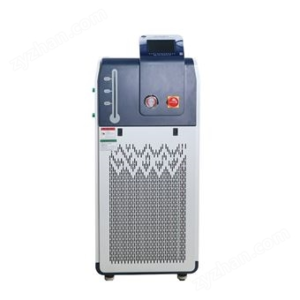
Laboratory High and Low Temperature Circulator
Laboratory High and Low Temperature Circulator 2026-8-27 Table of Contents What Is a Laboratory High and Low Temperature Circulator? A Laboratory High and Low Temperature
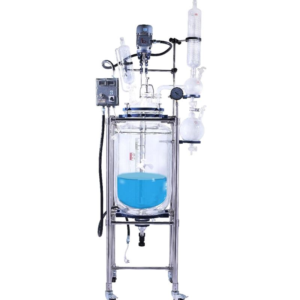
Laboratory Glass Reactor
Laboratory Glass Reactor 2026-8-31 Table of Contents What Is a Laboratory Glass Reactor? A laboratory glass reactor is a reaction vessel equipped with temperature